How System Design Interviews Work
On this page
What a system design interview tests
In a coding interview, your solution passes the tests or it doesn't. A system design interview has no tests. You're asked to "design a URL shortener" or "design a chat app", and the interviewer already knows several reasonable designs. What they're scoring is how you get to yours: the questions you ask, the numbers you use, the trade-offs you name, and how clearly you explain them.
These rounds usually appear for mid-level and senior roles, often one or two per interview loop, because structuring a large, vague problem under time pressure is a big part of those jobs.
The five stages of a 45-minute system design interview
Almost every round follows the same shape. Practice moving through it until you don't have to think about it; that's worth more than memorizing any particular system.
| Stage | Time in a 45-minute round | What you produce |
|---|---|---|
| Clarify requirements | about 5 min | A short list of what the system must do and how well |
| Estimate scale | about 5 min | Rough numbers: users, requests per second, storage |
| High-level design | 15 to 20 min | Components end to end, with the main request paths walked through |
| Deep dive | 10 to 15 min | Real depth on the one or two hardest parts |
| Wrap-up | about 5 min | Bottlenecks, trade-offs, what changes at 10x scale |
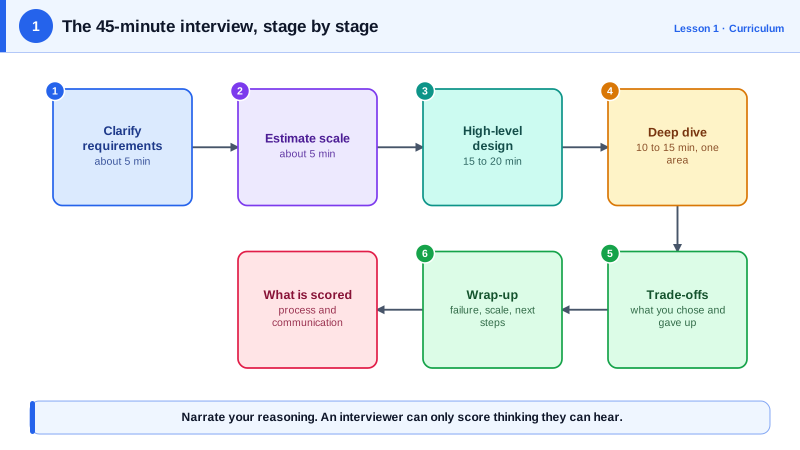
Each stage is scored, not just the final picture. That's why a candidate who draws a polished architecture in the first two minutes often does worse than one who asks good questions first: the first has shown no evidence of the skill being tested.
Two candidates, one prompt: why asking first wins
Both are asked to "design a file storage service".
Candidate A starts drawing within ninety seconds: a metadata service, a blob store, a sync client. Ten minutes later the interviewer asks, "Does this need offline editing with conflict resolution?" A never asked. They retrofit it under time pressure, lose several minutes, and their pacing never recovers.
Candidate B spends four minutes asking: Is it personal backup or shared folders? Real-time collaborative editing or just upload and download? Largest file size? Do we need version history? Then B designs. Every later choice (chunking big files, a metadata database, deduplicated storage) traces back to an answer B got at the start. The design is simpler than A's, and it scores better.
How system design interviews are scored
Interview rubrics vary by company, but they usually cover the same ground:
- Problem scoping: did you turn a vague prompt into clear requirements?
- Estimation: did you use numbers to make decisions?
- Design: does the architecture meet the requirements, end to end?
- Depth: can you go into detail where it matters, such as data models, consistency or failure handling?
- Trade-offs: do you know what each choice costs, and say so?
- Communication: could the interviewer follow your thinking without pulling it out of you?
Notice what's missing: naming the most technologies. Mentioning Kafka, Cassandra and Kubernetes without a reason counts against you.
What changes between mid-level and senior rounds
The prompt is often the same; the bar moves. Companies define levels differently, but the pattern is consistent. A mid-level candidate is expected to reach a working end-to-end design, and it's fine if the interviewer steers the deep dive. A senior candidate is expected to drive: pick the hardest part without being told, raise failure cases unprompted, and explain why the obvious alternative loses. At staff level and above, interviewers also listen for judgment about cost, operations and how the system will change over time.
So for a senior role, don't wait for the interviewer to choose your deep dive. Propose one: "The hard part here is making sure a sync conflict never loses an edit. I'd like to spend the deep dive there."
How this course is organized
Days 2 to 4 cover the method: requirements, estimation and high-level design. Days 5 to 10 apply it to six classic prompts, from a URL shortener to Dropbox. Days 11 and 12 cover follow-up questions and how to practice with mock interviews. If you need the underlying concepts, such as caching, replication or sharding, the System Design Roadmap course covers them in depth.
Check yourself
The interviewer is scoring your process. Without clarifying scope and scale first, you may design the wrong thing and you show no evidence of handling ambiguity.
About 5 minutes on requirements, 5 on estimation, 15 to 20 on the high-level design, 10 to 15 on a deep dive, and 5 on trade-offs and wrap-up.
If the simpler design meets the stated requirements and each part is justified, it shows judgment. Extra components without a reason suggest pattern-matching rather than design.
Propose the deep dive yourself: name the hardest part of this design and why, then start on it. Driving the conversation is part of what a senior round is testing.
Mid-level rounds mostly check that you can produce a working, sensible design. Senior rounds expect you to drive the conversation, choose where to go deep, weigh trade-offs explicitly, and discuss failure, operations and cost without being prompted.