System Design Interview Follow-Up Questions
On this page
Why the deep dive decides the interview
Your high-level design is on the board. Now the interviewer starts pushing: "What if the cache dies?" "What changes at ten times the traffic?" "Why not Cassandra?" This stretch, the deep dive, is where strong and average candidates separate, because there's no rehearsed diagram to fall back on.
The good news is that follow-ups are predictable in kind, even when the specifics aren't.
The four types of follow-up questions
| Type | Sounds like | What it's testing | How to answer |
|---|---|---|---|
| Failure | "What if this goes down?" "Two requests at once?" | Whether you think about failure | The concrete impact, then the mitigation |
| Scale shift | "What at 10x?" "Multiple regions?" | Whether your design rests on numbers | Go back to your estimate; name the first part that breaks |
| Trade-off | "Why not use Y?" | Whether you understand what you rejected | Y's real strength, then why it doesn't fit this requirement |
| Knowledge gap | A detail you don't know | Honesty and reasoning under uncertainty | Say so, reason from what you know, say how you'd find out |
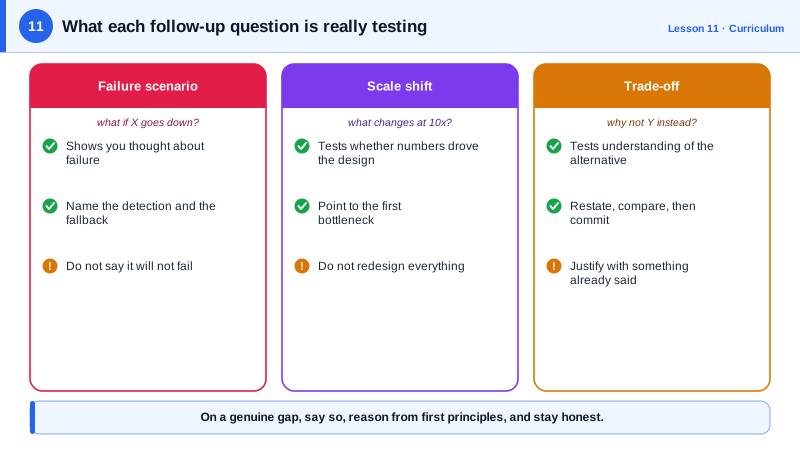
How to answer a deep-dive question in four steps
- Restate the problem in a sentence, to confirm you heard it right.
- Name two or three real options.
- Weigh them briefly: what each costs and buys.
- Commit to one, and justify it with something already on the board: a requirement, a number, a priority.
For example, asked how to stop a payment from being charged twice when the client retries: "So the risk is a retry after a timeout creating a second charge. Options: an idempotency key the client sends with each payment, stored under a unique constraint; a lock per order; or checking for a recent identical charge. A lock doesn't help if we crash between charging and recording the charge, and the duplicate check is a guess, so I'd use the idempotency key: the retry finds the stored key and gets the first result back instead of a new charge." The structure keeps you calm and makes your reasoning easy to follow. Day 12 shows the same four steps on a double-booking problem.
What to say when you don't know the answer
You'll be asked something you don't know. Here are two ways to handle "How does Raft elect a new leader after a partition?":
Guessing confidently. The candidate invents a mechanism and gets details wrong. Now the interviewer can't tell what else on the board was guessed too.
Bounding the gap. "I don't remember Raft's exact election steps. What I do know is the shape of the problem: nodes must agree on one leader even when some can't talk to each other, and these protocols use majority votes, so the minority side of a split can't elect a leader of its own. For a real system I'd use etcd rather than implement it, and I'd read the Raft paper before relying on the details."
The second answer shows exactly what interviewers want: judgment, honesty and a way forward. A small, clearly marked gap costs much less than a confident wrong answer.
Reading the interviewer's hints
A follow-up is often a hint. When an interviewer asks "how many writes per second was that again?", they may have spotted that your single database won't hold. When they ask the same question twice, your first answer probably missed what they were after. Treat pointed or repeated questions as a reason to recheck your design, and it's fine to ask directly: "Are you thinking about the write path?" Most interviewers will steer you if you let them.
Don't redesign on every follow-up
A narrow question deserves a narrow answer. If asked about the cache's failure behavior, answer that, not a new architecture. Changing your whole design after one push suggests you didn't believe in it. Change it only if the question reveals a real flaw, and say so: "Good point, that breaks my assumption about X, so I'd change Y."
Check yourself
Go back to the estimate, multiply, and find the first component that breaks, usually the database write path or a single hot key, then describe the specific change for that part.
Name DynamoDB's real strengths, such as automatic scaling, then the specific requirement that favors PostgreSQL here, such as transactions across tables or ad-hoc queries.
Say so directly, explain the general problem and approach you do understand, and say how you'd close the gap in a real project.
Questions like "what about the database here?" or "how would this behave at peak?" usually point at a weakness they want you to find. Pause, look at that part of the design, and address it directly instead of defending the original answer.
No. Most follow-ups need a targeted change to one component. Explain the change and its effect on the rest of the design, and keep the overall architecture stable so the interviewer can follow your reasoning.