System Design Interview: Clarifying Requirements
On this page
Clarifying requirements: turning "design Uber" into a plan
That prompt could mean the rider app, the driver app, matching, pricing, payments, maps, or all of it. Designing all of it in 40 minutes is impossible, so the interviewer expects you to narrow it. Those first five minutes decide what you'll design for the rest of the round.
The goal is two short written lists:
- Functional requirements: what the system does. "Riders request a ride; nearby drivers get offered it; one accepts."
- Non-functional requirements: how well. "Match within a few seconds; never assign one driver to two rides; handle 50,000 concurrent drivers."
Non-functional requirements are where most candidates stay vague. Check five every time: latency (how fast the main action must be), availability (how much downtime is acceptable), consistency (can users see stale data, and where not), durability (can data ever be lost) and scale. Put a number or a clear rule on each where you can: "matching in under 3 seconds for 99 percent of requests" gives you something to design against; "fast" doesn't.
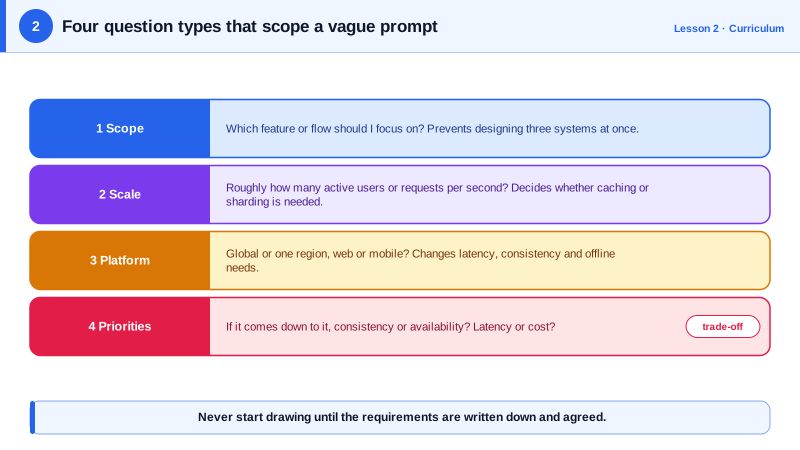
Four categories of clarifying questions
Go through them in order and you won't forget one.
| Category | Example question | Why it matters |
|---|---|---|
| Scope | Which flow should I focus on? What's out of scope? | Keeps you to one system instead of three |
| Scale | How many users, requests, how much data? More reads or writes? Growing how fast? | Decides whether you need caching, sharding or queues at all |
| Platform | Web or mobile? One region or global? Existing systems to integrate? | Changes the importance of latency, offline support, data residency |
| Priorities | If we have to choose: consistency or availability? Latency or cost? | Sets the stance the rest of the design follows |
Example: clarifying questions for "design Uber"
In about ninety seconds, "design Uber" has become "matching and trip lifecycle for on-demand rides in one city, with payments external, where correct assignment beats speed." That's designable in 40 minutes, and the last answer tells you matching needs a consistency guarantee, which you'll come back to in the deep dive.
Then write the lists where the interviewer can see them, read them back, and ask "Anything I've missed?" That confirmation costs ten seconds and prevents the retrofit that sank Candidate A on Day 1.
Why scale questions change the design
The right design for 10,000 users looks nothing like the right design for 100 million. A single PostgreSQL instance with a read replica is a good answer at small scale. Proposing sharding and a distributed cache for a system that doesn't need them is a bigger red flag than under-building, because it suggests you're reciting a study guide rather than designing for the problem in front of you.
If the interviewer says "you decide", pick a number, say it out loud, and move on: "I'll assume 10 million daily active users."
Two common mistakes when clarifying requirements
- Assuming instead of asking. You end up designing for a problem the interviewer didn't pose.
- Asking for too long. Fifteen minutes of questions eats the time you need for design and depth. Interviewers notice when a candidate can't move on. Five minutes, then start.
Check yourself
One per category, for example: which part (posting, feed generation, ranking)? How many daily users and posts per user? Is it acceptable for a new post to take a few seconds to appear, or must it be instant?
Stop gathering and summarize: list the requirements you've agreed, state assumptions for anything still open, such as "I'll assume 10 million daily users", and confirm with the interviewer before moving to estimation. Requirements should take five to ten minutes; past that you risk running out of time for the design itself.
It sets the direction for storage, replication and failure handling. In the ride example, "double-booking is worse" means matching needs a consistent assignment step.
Users and features (who uses it and what must it do), scale (how many users, requests and how much data), constraints and quality attributes (latency, consistency, availability), and scope (what's explicitly out). Covering all four quickly prevents designing the wrong system.
It spends limited time on things that don't score and makes the design harder to explain. Interviewers want to see you scope the problem, so state what you're leaving out and why, and spend the time on the core flow.