What Is the OWASP Top 10? The 2025 List Explained
On this page
A shared vocabulary for "what usually goes wrong"
A security review without a starting point turns into a long, shapeless argument. The OWASP Top 10 gives teams a short, ranked list of the risks that show up most often, and do the most damage, in real web applications.
OWASP is the Open Worldwide Application Security Project, a nonprofit that publishes free security material. The Top 10 is its best-known project. Each entry is a category of risk, not a single bug. Each category maps to a group of CWEs (Common Weakness Enumeration entries, a standard catalog of weakness types). Broken Access Control alone covers 40 of them.
How the 2025 list was built
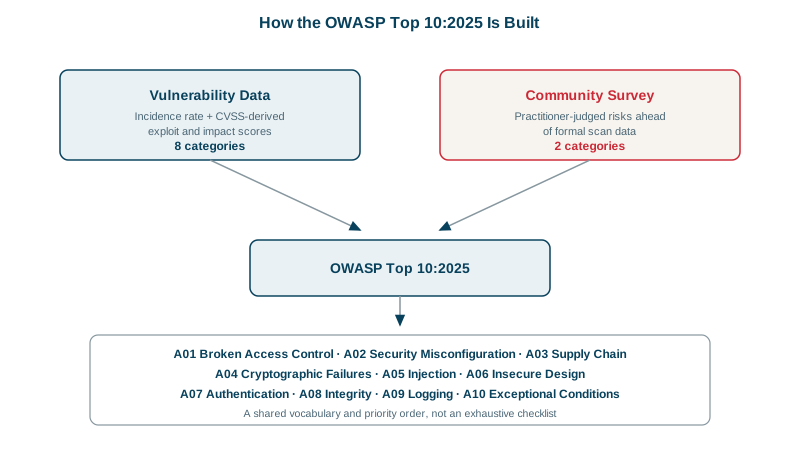
OWASP calls its method "data-informed, not blindly data-driven". Two inputs feed it:
- Test data. Organizations and tool vendors contributed results from testing real applications. This edition analyzed 589 CWEs, and the final list maps 248 of them into the ten categories. OWASP ranks categories by how many applications had at least one weakness in them (incidence), plus exploit and impact scores taken from CVE data.
- A community survey. Testing data lags behind what practitioners see, because some problems are hard to test for automatically. So only eight categories come from the data. The other two are promoted by a survey of people working in the field.
In 2025 the survey promoted A03 Software Supply Chain Failures, which OWASP says was "overwhelmingly voted a top concern", and A09 Security Logging and Alerting Failures, which the survey has kept on the list since 2021.
The 2025 list explained, with changes since 2021
| 2025 | Category | 2021 rank | What changed |
|---|---|---|---|
| A01 | Broken Access Control | 1 | Still first; Server-Side Request Forgery (SSRF) folded in |
| A02 | Security Misconfiguration | 5 | Up three places |
| A03 | Software Supply Chain Failures | 6 | Widened from "Vulnerable and Outdated Components" |
| A04 | Cryptographic Failures | 2 | Down two |
| A05 | Injection | 3 | Down two |
| A06 | Insecure Design | 4 | Down two |
| A07 | Authentication Failures | 7 | Renamed from "Identification and Authentication Failures" |
| A08 | Software or Data Integrity Failures | 8 | Same place |
| A09 | Security Logging and Alerting Failures | 9 | "Monitoring" became "Alerting" |
| A10 | Mishandling of Exceptional Conditions | new | New category |
A drop in rank doesn't mean a risk went away. Injection fell partly because frameworks now parameterize queries and escape templates by default, so testers find it less often. When it does appear, it's still severe.
How to read one entry
Each category page on owasp.org gives the numbers behind its rank: the CWEs it maps, the incidence rate and average exploit and impact scores. For example, A01 maps 40 CWEs with an average incidence of 3.73%. A03 has the fewest occurrences in the data but the highest average exploit and impact scores. That combination tells you something: supply chain problems are hard to find with today's tests, and painful when they hit.
Turn an entry into a question you can check in a code review. For A05 that's: "Does every query in this change pass user input as a parameter, never by building strings?" The lessons that follow do this for all ten.
What the Top 10 is not
- Not a complete list. An application can be clean on all ten categories and still have a serious flaw that didn't rank industry-wide.
- Not a certification. "We passed an OWASP Top 10 scan" means a scanner found nothing in the patterns it knows. Scanners struggle with access control and design flaws, which rank high.
- Not a threat model. It tells you what tends to go wrong everywhere. Threat modeling tells you what matters for your system.
Use it as a floor: a training plan, a review checklist and a shared language. Compliance standards treat it the same way. PCI DSS, the card payment standard, points to OWASP guidance as an example of the industry secure coding practices it expects.
Check yourself
The Top 10 covers common categories, not every flaw, and scanners miss much of access control and insecure design. Zero findings is a baseline, not proof of security.
A03 Software Supply Chain Failures and A09 Security Logging and Alerting Failures. Test data misses risks that are hard to test automatically, so practitioners get a vote on two places.
Not much less. It's found less often because frameworks parameterize and escape by default, but when it exists it's still easy to exploit and the impact is high.
It's an awareness document ranking the most significant categories of web application security risk, built from contributed vulnerability data and a community survey. It isn't a complete security standard or a checklist that proves an application is secure; standards like OWASP ASVS go much further.
As shared vocabulary and a starting point: map each category to concrete practices in your stack, such as access checks in every handler or dependency scanning in CI, and to code review questions. Then go deeper with ASVS and threat modeling for your own risks.