Authentication Failures (OWASP A07:2025)
On this page
Credential stuffing vs brute force
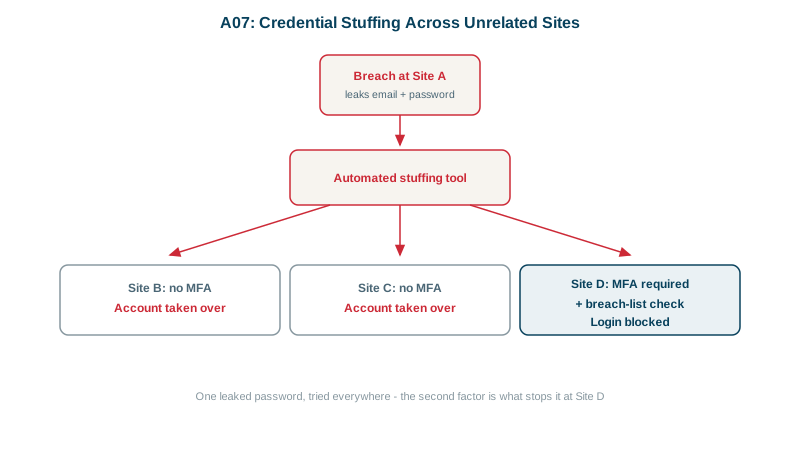
Billions of username and password pairs from old breaches are public. Many people reuse passwords, so attackers replay those pairs against other sites automatically. This is credential stuffing. It differs from brute force, which tries many passwords against one account. Credential stuffing tries one known password per account, across many sites.
In 2023 attackers used credential stuffing to get into about 14,000 23andMe accounts without multi-factor authentication (MFA). Through a feature that shared data between relatives, that exposed information on about 6.9 million people.
Good authentication assumes some users' passwords are already known to attackers.
User enumeration through login timing
A careful team returns one message for "no such user" and "wrong password", so attackers can't tell which emails are registered. Here's that login, with Argon2id hashing (Day 5):
function loginV1(email, pw) {
  const u = users.get(email);
  if (!u) return false;                                   // returns immediately
  return crypto.timingSafeEqual(hash(pw, u.salt), u.hash); // ~25 ms of hashing
}
Average over 20 wrong-password attempts:
v1 existing 26.6 ms v1 unknown 0.0 msThe message is identical, but the timing isn't. A known email takes 26 ms, an unknown one returns at once. An attacker can sort a list of emails into "registered" and "not registered" from response times alone.
The fix is to do the same work either way, hashing against a dummy record when the user doesn't exist:
function loginV2(email, pw) {
  const u = users.get(email) ?? DUMMY;
  const ok = crypto.timingSafeEqual(hash(pw, u.salt), u.hash);
  return ok && u !== DUMMY;
}v2 existing 25.7 ms v2 unknown 25.6 msSignup and password reset leak the same information ("that email is taken"), so rate-limit them too.
The defences that stop credential stuffing
- MFA. A leaked password alone stops working. Passkeys and other phishing-resistant methods are stronger than SMS codes.
- Check passwords against breach lists at signup and change, for example with the Have I Been Pwned range API.
- Follow NIST SP 800-63B (Revision 4, 2025): at least 15 characters when the password is the only factor (8 with MFA), no forced character mixes, and no forced periodic changes unless there's evidence of compromise.
- Throttle failures per account and per source address, and alert on spikes (Day 10).
- Manage sessions properly: random server-issued IDs,
HttpOnly,SecureandSameSitecookies, expiry, and invalidation on logout and password change.
JWT validation: audience, issuer and algorithm
Services that accept JSON Web Tokens (JWTs) often only check the signature. In this test (HS256 with a shared secret) the auth server issued a token for reports-service, and the billing service verifies it:
jwt.verify(token, secret);no aud check: alice acceptedThe signature is valid, so billing accepts a token that was never meant for it. Pin what you expect:
const payload = jwt.verify(token, key, {
  algorithms: ['RS256'],               // never let the token choose
  audience: 'billing-service',
  issuer: 'https://auth.acme.example/',
});
if (!payload.scope?.split(' ').includes('billing:read')) return res.status(403).end();aud pinned: JsonWebTokenError jwt audience invalid. expected: billing-servicePinning algorithms blocks tokens that name a different algorithm.
ASP.NET Core's JWT bearer handler validates issuer, audience, lifetime and signature by default once you configure them:
builder.Services.AddAuthentication().AddJwtBearer(o =>
{
    o.Authority = "https://auth.acme.example/";
    o.Audience = "billing-service";                              // tokens for other services fail
    o.TokenValidationParameters.ValidAlgorithms = new[] { "RS256" };
});
The common way to break it is a fix for an error message: a token fails with an audience error during development, and someone sets ValidateAudience = false. That's exactly the hole shown above. Fix the audience the token is issued for instead. jsonwebtoken 9 already rejects unsigned alg: none tokens (jwt signature is required), but older libraries and hand-written checks have accepted them.
Check yourself
Response timing. If the password hash only runs for existing users, those responses are measurably slower. Hash against a dummy record for unknown users.
Brute force guesses many passwords for one account; credential stuffing replays leaked pairs across many accounts. MFA stops it best, because the correct password alone no longer works.
A correctly signed token may have been issued for another service or by another issuer. Without those checks, any token from the same key works everywhere.
Credential stuffing uses passwords leaked from other sites, so the password is often correct. MFA requires something the attacker doesn't have, such as a passkey or authenticator code, so a valid password alone isn't enough. Passkeys also resist phishing.
Some libraries once accepted tokens whose header said alg: none, meaning unsigned, so attackers could forge any claims. Configure validation with an explicit list of allowed algorithms and keys, and never let the token's header choose how it's verified.