Elasticsearch Query DSL: Match vs Term vs Bool
On this page
Full-text vs exact-value questions
- "Find documents about database performance" is a full-text question. The query text should be analyzed like the field (Day 6). That's
match. - "Find articles by author ana" is an exact question about a structured value. That's
term.
Mixing them up is the most common beginner bug.
The match query for full text
GET /articles/_search
{ "query": { "match": { "title": "Database Performance Myths" } } }total 3
3 4.759 Database Performance Myths
7 0.942 Network Performance Basics
1 0.850 Tuning Databases for PerformanceThe query is analyzed into database, performance, myths; any document with any of them matches, ranked by how well it matches. Options:
"operator": "and"requires every term."minimum_should_match": "75%"requires most.match_phraserequires the terms in order and adjacent.
The term query for exact values
GET /articles/_search
{ "query": { "term": { "author": "ana" } } }total 2
1 1.163 Tuning Databases for Performance | ana
3 1.163 Database Performance Myths | anaterm doesn't analyze its input. On a keyword field that's exactly what you want, and it's case-sensitive: "Ana" found nothing.
Why a term query on a text field finds nothing
GET /articles/_search
{ "query": { "term": { "title": "Database Performance Myths" } } }total 0The index holds the lowercase terms database, performance, myths, never the whole string Database Performance Myths, so an exact term lookup finds nothing. Use match on text fields, and term on keyword fields (or the .keyword subfield). Related queries: terms (any of several values), range (numbers and dates), exists, prefix.
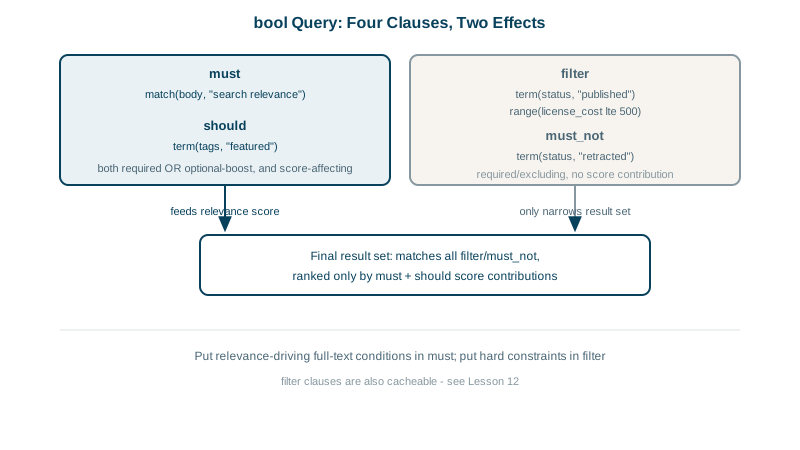
The bool query: must, should, filter, must_not
| Clause | Must match? | Affects score? |
|---|---|---|
must | Yes | Yes |
should | Optional (unless there's no must or filter), raises score | Yes |
filter | Yes | No (cacheable, Day 12) |
must_not | Must not match | No |
A product search: wireless items, in electronics, at most 50, in stock:
GET /products/_search
{
  "query": {
    "bool": {
      "must":   [ { "match": { "description": "wireless" } } ],
      "filter": [
        { "term":  { "category": "electronics" } },
        { "range": { "price": { "lte": 50 } } },
        { "term":  { "in_stock": true } }
      ]
    }
  }
}total 2
102 1.162 Wireless Keyboard | 49.99 | True
101 1.068 Wireless Mouse | 24.99 | TrueOnly the text match affects ranking; the yes/no constraints sit in filter. Bool queries nest, so complex logic stays readable.
Check yourself
The text field was analyzed into separate lowercase terms, database, performance and myths, at index time. A term query isn't analyzed, so it looked for the exact full string, which never exists in the index. Use match for text, or term on a keyword subfield.
For yes or no conditions that shouldn't influence relevance, such as category, price range or stock status. Filters skip scoring and can be cached, so they're faster, and the ranking reflects only the text query.
Set "operator": "and" on the match query, or use minimum_should_match, such as "75%", to require most words. The default or operator returns documents matching any word.
It excludes matching documents and runs in filter context, so it doesn't affect the scores of the remaining documents and its results can be cached. It's the right place for exclusions like discontinued products.
When words must appear together and in order, like new york. Use slop to allow a few words in between.