Vibe Coding vs Agentic Engineering Explained
On this page
Learning Objective
Understand the spectrum of AI-assisted coding, from autocomplete to autonomous background agents, and the difference between vibe coding, where you accept code you have not read, and agentic engineering, where you direct an agent and stay accountable for the result. Decide which mode fits a given piece of work.
Concept Explanation
In February 2025 Andrej Karpathy described a new way he was writing throwaway projects: "fully give in to the vibes", accept every change the AI suggests, paste error messages back without reading the code, and see if it works. He called it vibe coding, the phrase spread instantly, and by the end of the year Collins Dictionary had named it its word of the year. The term is useful because it names something real: for the first time, people can produce working software without understanding the code.
That is perfectly reasonable for some work. A weekend prototype, a one-off script to rename files, a demo to test an idea with users: if it breaks, you throw it away. The problem starts when vibe-coded software becomes something people depend on. Code nobody has read can contain security holes, silent data loss, and design choices that make the next change impossible. The bill arrives later, and the person who has to pay it often is not the one who generated the code.
Professional AI-assisted coding is better described as agentic engineering. You still use powerful agents that read the codebase, edit many files and run commands, but you remain the engineer. You decide what to build and how it should fit the system, you give the agent the context and constraints it needs, you make it prove its work with tests, and you review what it produced before it ships. The agent does more of the typing; you do more of the specifying, reviewing and deciding. Simon Willison has called this vibe engineering, to make the contrast with vibe coding explicit.
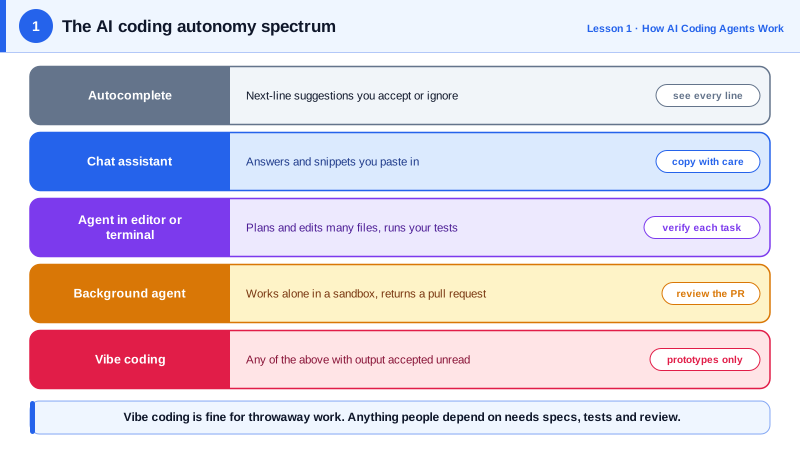
It helps to see the tools as a spectrum of autonomy. Inline autocomplete suggests the next line and you accept or ignore it. Chat assistants answer questions and produce snippets you paste in. Agents in your editor or terminal, such as Claude Code, Cursor's agent, GitHub Copilot's agent mode or OpenAI Codex, plan and carry out multi-file changes and run your tests. Background agents take a task, work in a cloud sandbox for minutes or hours, and come back with a pull request. Each step up multiplies how much you can delegate and how much you must verify.
The skills this course teaches apply across all of these tools: giving agents good context, specifying work clearly, keeping changes small and verified, customizing the agent's behavior, and protecting your codebase and machine. The specific commands differ between tools; the discipline does not.
| Mode | What you do | Good for | Risk |
|---|---|---|---|
| Autocomplete | Accept or reject next-line suggestions | Boilerplate, familiar patterns | Low, you see every line |
| Chat assistant | Ask questions, paste snippets | Learning, small isolated pieces | Copying code you do not understand |
| Vibe coding | Accept everything, judge only by behavior | Throwaway prototypes and scripts | Hidden bugs, security holes, unmaintainable code |
| Agentic engineering | Specify, delegate, verify, review | Production features, refactors, fixes | Review fatigue if changes are too large |
| Background agents | Assign a task, review the pull request | Well-specified, test-covered tasks | Large diffs, unclear reasoning |
Worked Example: The Same Request, Vibe-Coded and Engineered
Both prompts ask an agent to add CSV export to an admin page. The first is a vibe-coding prompt. The second gives the agent constraints, points to existing patterns and defines how to verify the result.
# Vibe coding: fine for a prototype, risky for production
add a button to export users as csv

# Agentic engineering: same feature, with context, constraints and verification
Add CSV export to the admin Users page.

Context:
- The page is src/admin/users/UsersPage.tsx; the data comes from GET /api/admin/users.
- We already export orders as CSV in src/admin/orders/exportOrders.ts. Follow that pattern.

Requirements:
- Export the currently filtered list, not just the visible page.
- Columns: id, email, name, created_at, plan. Never include password_hash or api_token.
- Escape commas, quotes and newlines correctly; leading = + - @ must be neutralized
  to prevent CSV formula injection in Excel.
- Only users with the admin role can call the export endpoint.

Verification:
- Add unit tests for escaping and for the excluded columns.
- Run npm test and npm run lint, and show me the results before you finish.
- Keep the change under roughly 200 lines; ask me before touching auth middleware.
The second prompt takes two minutes longer to write. In exchange, the agent reuses an existing pattern, avoids leaking sensitive columns, handles a real security issue and proves its work, which is the difference between a demo and a feature.
Real-World Examples
- Andrej Karpathy coined the term vibe coding in a post on 2 February 2025, describing it as suitable for "throwaway weekend projects", and Collins Dictionary chose vibe coding as its 2025 word of the year.
- The 2026 Stack Overflow Developer Survey found that 84 percent of respondents use or plan to use AI tools and that Claude Code (66 percent) and GitHub Copilot (59 percent) were the most used coding agents, while developers still reported they rarely let AI operate production systems.
Review Questions & Answers
In vibe coding you accept AI-generated code without reading it and judge only whether it seems to work. In agentic engineering you direct the agent with context and constraints, require verification such as tests, and review the result, staying accountable for what ships.
For throwaway work where failure is cheap: weekend prototypes, one-off scripts, quick demos to test an idea. It becomes risky when other people or systems will depend on the code.
Each step lets the AI produce larger changes with less of your direct attention, so more code reaches the codebase that you did not write line by line. Tests and review are what keep that code trustworthy.
Context about existing code and patterns, explicit requirements including excluded sensitive columns and formula-injection protection, an authorization constraint, a size limit, and a verification step with tests and lint results.