Rolling Out AI Coding Tools to a Team: Policy and Metrics
On this page
Learning Objective
Plan a responsible team or organization rollout of AI coding agents: set policies on tools, data and accountability, share configuration and enforce baselines with managed settings, enable people with training and champions, and measure impact with delivery metrics rather than usage counts.
Concept Explanation
Individual developers can adopt agents in an afternoon. Teams need more, because the risks and benefits are collective: one developer's permissive setup can leak a secret, one team's unreviewed generated code becomes everyone's maintenance burden, and the productivity gains depend on shared practices more than on individual skill. The DORA research summarizes it: AI amplifies the system it enters (Day 5), so improving the system is part of adopting AI.
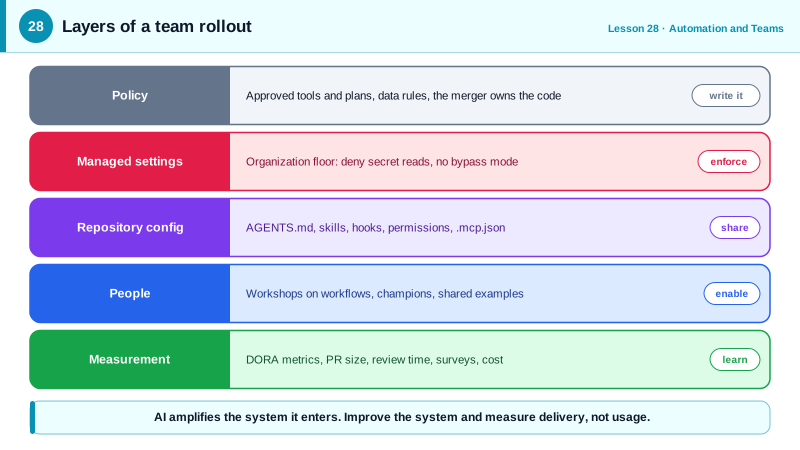
Start with policy, kept short and practical. Which tools are approved, and on which plans, so that code and data go only to providers with acceptable terms on retention and training. What data may be used: usually source code yes, customer data and secrets no. Accountability: the person who merges code owns it, however it was produced, and AI-generated code goes through the same review and checks. Disclosure expectations, for example noting significant agent involvement in pull requests. And which actions agents may never take, such as using production credentials or bypassing review.
Then share configuration so good practice is the default. Commit the project instruction file, skills, subagents, hooks, permission rules and MCP configuration to each repository (Days 7, 16 to 20), so every developer and every agent gets the same context and guardrails. For organization-wide baselines, use managed settings: in Claude Code, a managed-settings.json file deployed by IT, an MDM policy, or server-managed settings from the admin console take precedence over user and project settings and can, for example, deny reading secret files everywhere, disable the bypass permission mode, or allow only organization-approved hooks and permission rules.
Enable people deliberately. Short workshops on the workflows in this course help more than tool demos: context engineering, plan mode, TDD with agents, reviewing AI code. Identify champions in each team who share prompts, skills and lessons. Create a channel for questions and examples. Expect a learning curve; the METR results suggest that early use can slow experienced developers down even as they feel faster.
Measure what matters. Usage numbers, such as seats active or suggestions accepted, show adoption, not value. Track delivery outcomes: lead time for changes, deployment frequency, change failure rate and time to restore, the four DORA metrics, plus pull request size and review time. Survey developers on satisfaction and on where agents help or hurt. Review costs, especially usage-based API spend for agents and CI automation, against those outcomes. Revisit the policy every quarter; the tools change fast.
| Area | Decision or practice | Example |
|---|---|---|
| Approved tools and data | Which tools, plans and data are allowed | Business plans only; no customer data in prompts |
| Accountability | Who owns AI-generated code | The merger owns it; same review and checks |
| Shared configuration | Repository-level context and guardrails | AGENTS.md, skills, hooks, .claude/settings.json |
| Organization baseline | Managed settings | Deny secret reads, disable bypass mode |
| Enablement | Training, champions, shared examples | Workshops on plan mode and TDD with agents |
| Measurement | Outcomes, not usage | DORA metrics, PR size, review time, surveys |
Worked Example: A Managed Settings Baseline
This organization-wide managed settings file, deployed by IT to every developer machine or set in the admin console, establishes guardrails that individual and project settings cannot loosen.
{
  "permissions": {
    "deny": [
      "Read(./.env)",
      "Read(./.env.*)",
      "Read(./**/secrets/**)",
      "Read(~/.aws/**)",
      "Read(~/.ssh/**)",
      "Bash(terraform apply *)",
      "Bash(kubectl delete *)"
    ],
    "ask": [
      "Bash(git push *)"
    ],
    "disableBypassPermissionsMode": true
  },
  "env": {
    "CLAUDE_CODE_ENABLE_TELEMETRY": "1"
  }
}
Projects still add their own allow rules, skills and hooks; the managed layer only guarantees the floor. Telemetry, sent to the organization's own OpenTelemetry collector, gives the platform team usage and cost data to set against the delivery metrics, without reading anyone's prompts.
Real-World Examples
- The 2025 DORA report found that AI adoption improved throughput but could increase instability in teams without strong foundations, and introduced an AI Capabilities Model of practices, such as a clear AI policy, healthy data, strong version control and small batches, that predict whether adoption pays off.
- Claude Code's settings documentation places managed settings, delivered by a managed-settings.json file, MDM or the admin console, at the top of the precedence order, above command line, project and user settings, so organizations can enforce baselines such as deny rules and disabled bypass mode.
Review Questions & Answers
Risks and benefits are shared: one permissive setup can leak secrets for everyone, generated code becomes a team maintenance burden, and gains depend on shared practices such as review, testing and small batches.
They take precedence over user, project and command line settings, so an organization can enforce a baseline, such as denying secret reads or disabling bypass mode, that individuals cannot loosen.
They show that tools are used, not that delivery improved. Outcome metrics like lead time, change failure rate and review time reveal whether teams actually ship better software faster.
The person who merges it, under the same review and checks as any other code, regardless of how much of it an agent produced.