Will AI Replace Junior Developers? Learning with AI
On this page
Learning Objective
Use AI agents in ways that build your skills rather than erode them, understand what the evidence says about learning and early-career employment, and adopt concrete habits, for you and for the juniors you mentor, that keep your judgment strong as agents write more code.
Concept Explanation
Every earlier lesson assumed a capable engineer directing the agent: someone who can write a good spec, spot a wrong design, read a diff critically and debug when the agent cannot. Those abilities come from practice, and agents make it easy to skip the practice. That is the central career question of AI-assisted development: how do you keep, and build, the judgment that makes you valuable when the agent does much of the typing?
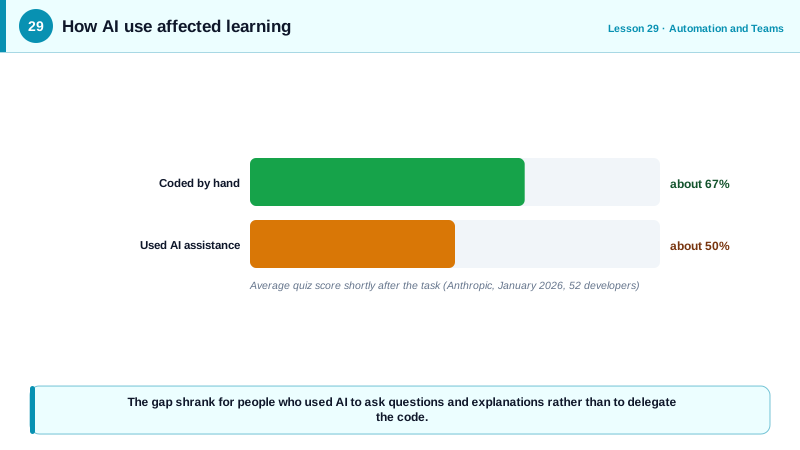
The evidence is a warning, not a verdict. In Anthropic's January 2026 randomized study, developers learning a new Python library with AI help scored 17 percent lower on a comprehension quiz than those coding by hand, while finishing only slightly faster. But the gap depended on how people used AI: those who asked conceptual questions, requested explanations and wrote code themselves retained much more than those who delegated the code and moved on. The tool does not decide the outcome; the way you use it does.
The job market adds urgency. Stanford Digital Economy Lab research published in August 2025, using payroll data covering millions of workers, found employment for software developers aged 22 to 25 had fallen nearly 20 percent from its late-2022 peak, while employment of more experienced developers held steady or grew. Whatever the causes, the work agents absorb first is the routine work through which juniors traditionally learned. Teams that want senior engineers in five years must deliberately create learning paths today.
Several habits keep skills growing. Understand before you accept: if you cannot explain a change, ask the agent to explain it, or work it out, before merging. Use learning modes: Claude Code's Learning output style asks you to write key pieces yourself, and most assistants can be told to explain and quiz rather than solve. Keep some deliberate practice without AI, such as implementing an algorithm or debugging an issue by hand, especially in areas central to your role. Read the agent's trajectories and plans as a way to learn new codebases and techniques. And invest in the skills agents amplify most: system design, specification, testing strategy, security, code review and communication.
For mentors and teams, the structural fixes matter more than individual willpower. Pair juniors with agents and seniors, with the junior driving and explaining. Review juniors' agent-assisted pull requests with questions, not just approvals: why this approach, what else did you consider. Rotate juniors through debugging and incident work. And keep some tasks as learning tasks, where speed is not the goal.
| Habit | What it builds | How |
|---|---|---|
| Explain before merging | Understanding of every change | Ask for or write an explanation |
| Learning mode | Hands-on skill with support | Agent explains and asks you to write key parts |
| Deliberate practice without AI | Core fluency | Regular hand-written algorithms and debugging |
| Read trajectories and plans | New techniques and codebases | Study how the agent investigated |
| Invest in amplified skills | Design, specs, testing, security, review | Courses, design reviews, writing |
| Structured mentoring | Juniors' judgment | Pairing, questioning reviews, incident rotation |
Worked Example: A Personal Learning Configuration
A developer learning a new stack switches Claude Code to a learning-oriented setup with a personal, gitignored instruction file and the Learning output style.
<!-- CLAUDE.local.md (personal, gitignored) -->
## How I want to work while learning Rust
- Before writing code, explain the approach and the Rust concepts involved (ownership,
  borrowing, lifetimes) in a few sentences, then ask me if I want to try it myself first.
- For anything under 20 lines in src/parser/, give me hints and let me write it. Review my
  version afterwards and explain what you would change and why.
- When you fix a compiler error, explain what the borrow checker was protecting against.
- After each task, ask me two short questions about what we just did. Tell me if I got them wrong.
- Never paste large solutions for exercises in exercises/; those are for practice.# In the session, switch to the built-in Learning output style:
/output-style learning
# Once a week, a deliberate-practice session without the agent:
# implement one function from the backlog by hand, then ask the agent to review it.The instruction file turns the agent from an answer machine into a tutor for one part of the codebase, while the rest of the work can proceed at full speed. The weekly hand-written session keeps fluency that pure delegation would erode.
Real-World Examples
- Anthropic's January 2026 study of 52 mostly junior developers found AI-assisted learners averaged about 50 percent on a comprehension quiz versus about 67 percent for those coding by hand, and that participants who used AI to ask conceptual questions retained substantially more than those who delegated code generation.
- Brynjolfsson, Chandar and Chen's August 2025 Stanford Digital Economy Lab paper "Canaries in the Coal Mine?" used ADP payroll data to show a relative employment decline of about 13 percent for early-career workers in AI-exposed occupations, with software developers aged 22 to 25 down nearly 20 percent from late 2022.
Review Questions & Answers
Developers who learned a new library with AI help scored about 17 percent lower on a comprehension quiz, but those who used AI to ask conceptual questions and get explanations retained much more than those who simply delegated the code.
The routine work agents absorb first is the work through which juniors traditionally learned, so teams that want experienced engineers in future must create deliberate learning paths now.
Explaining or understanding every change before merging, using learning modes where you write key parts yourself, keeping regular practice without AI, and reading the agent's plans and trajectories to learn techniques.
System design, writing clear specifications, testing strategy, security thinking, code review and communication, because they determine the quality of what agents produce.