OWASP Top 10 Overview for Developers
On this page
What is the OWASP Top 10?
The OWASP Top 10 is a list of the most critical web application security risks, built from data on hundreds of thousands of applications and a community survey. It's not a complete checklist, but it's the common vocabulary for developers, testers and auditors. The 2025 edition is current.
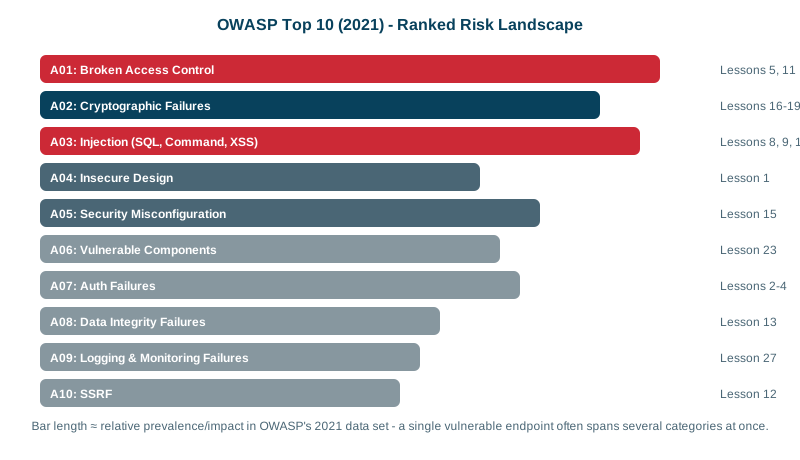
The OWASP Top 10 2025 list explained
| # | Category | In practice |
|---|---|---|
| A01 | Broken Access Control | Users reach data or functions they shouldn't: IDOR, missing checks, and now SSRF (Days 11, 12) |
| A02 | Security Misconfiguration | Default credentials, debug mode, open storage, verbose errors (Day 15) |
| A03 | Software Supply Chain Failures | Vulnerable or malicious dependencies, compromised build tools (Day 23) |
| A04 | Cryptographic Failures | Plaintext data, weak algorithms, bad key handling (Days 16 to 19) |
| A05 | Injection | SQL, command, and cross-site scripting injection (Days 8, 9, 14) |
| A06 | Insecure Design | Missing threat modeling, flawed business logic (Days 1, 28) |
| A07 | Authentication Failures | Weak passwords, missing MFA, broken sessions (Days 2 to 4) |
| A08 | Software or Data Integrity Failures | Unsigned updates, insecure deserialization (Day 13) |
| A09 | Security Logging and Alerting Failures | Attacks that nobody notices (Day 27) |
| A10 | Mishandling of Exceptional Conditions | Errors that fail open, leak details or leave inconsistent state |
Compared with 2021: supply chain risk gained its own category and rose to third, SSRF folded into broken access control, and the new A10 covers error handling that fails unsafely, such as an authorization check that grants access when its policy service times out.
Example: four OWASP risks in eight lines of code
// GET /api/invoices/:id
app.get('/api/invoices/:id', requireLogin, (req, res) => {
  const sql = `SELECT * FROM invoices WHERE id = ${req.params.id}`;   // A05: injection
  db.query(sql, (err, rows) => {
    if (err) return res.status(500).send(err.stack);                 // A02/A10: leaks internals on error
    res.json(rows[0]);                                                // A01: no ownership check
  });
});- A05 Injection: the ID is concatenated into SQL;
1 OR 1=1returns the first invoice in the table (Day 8). - A01 Broken Access Control: any logged-in user can read any invoice by changing the ID (Day 11).
- A02 / A10: a database error sends a stack trace to the client, revealing internals.
- And
SELECT *returns every column, including ones the client shouldn't see.
The fixed version:
app.get('/api/invoices/:id', requireLogin, async (req, res) => {
  const { rows } = await db.query(
    'SELECT id, number, total, status FROM invoices WHERE id = $1 AND customer_id = $2',
    [req.params.id, req.user.customerId]);                  // parameters + ownership in one query
  if (!rows.length) return res.status(404).json({ title: 'Not found' });
  res.json(rows[0]);
});
// plus an error handler that logs details and returns a generic problem response
How to use the OWASP Top 10 well
- Learn the categories so you recognize them in code review.
- Don't treat it as a compliance checklist. OWASP's ASVS (Application Security Verification Standard) is the detailed, testable requirements list.
- Look at the related lists: the OWASP API Security Top 10 (see the API design course) and the OWASP Top 10 for LLM Applications (see the AI security course).
Check yourself
Broken Access Control. It was the most common category in the data behind both editions, covering users acting outside their intended permissions, such as viewing other users' records or using admin functions.
It was folded into A01 Broken Access Control, since SSRF lets an attacker make the server access resources it shouldn't. The defenses, such as destination allow-lists and network egress controls, haven't changed.
An authorization check that allows the request when the policy service errors or times out, instead of denying it. Attackers who can trigger that error, for example with a malformed request or by overloading the service, bypass authorization entirely.
No. It's an awareness document about the most common and impactful risk categories, built from industry data. For thorough, testable requirements, use the OWASP Application Security Verification Standard (ASVS).
As a shared vocabulary for training and code review, mapping each category to the concrete controls and tests your stack needs.