Multi-Agent Systems and the A2A Protocol Explained
On this page
Learning Objective
Decide when several cooperating agents beat one, design the handoffs between them, and understand the Agent2Agent (A2A) protocol for agents that talk across teams and vendors, including how it complements MCP.
Concept Explanation
A multi-agent system splits work between several model-driven loops, each with its own instructions, tools and context window. The orchestrator-workers pattern from Day 7 is the most common form; others include handoffs, where one agent passes the conversation to a specialist, and pipelines, where agents work in sequence on an artifact. The appeal is real: separate contexts keep each agent focused, parallel agents cover breadth quickly, and specialists can use different models, tools and permissions.
The costs are just as real. Every agent re-reads its own instructions and context, so token usage multiplies; Anthropic reported that its multi-agent research system used about fifteen times more tokens than a chat interaction. Coordination is hard: agents duplicate work, contradict each other, or lose information at handoffs because each sees only its brief. Debugging means following several interleaved transcripts. Cognition, the company behind Devin, argued in 2025 that for tasks such as coding, where every decision depends on earlier ones, a single agent with well-managed context is usually more reliable than many agents that cannot see each other's choices.
A useful rule follows from both views. Multi-agent designs pay off when the work is broad and parallelizable, subtasks are fairly independent, and the value justifies the extra tokens: research across many sources, reviewing many files, processing many records. They fit poorly when subtasks share many dependencies and each step must build on the precise decisions of the previous one. When you do split, make handoffs explicit: the brief, the expected output format, and the facts every agent must share.
Inside one application, agents usually communicate through function calls in the same process, for example subagents in the Claude Agent SDK or handoffs in the OpenAI Agents SDK. Across organizational or vendor boundaries you need a protocol. The Agent2Agent protocol, launched by Google in April 2025, donated to the Linux Foundation in June 2025 and stable at version 1.0 since April 2026, fills that role. An A2A server publishes an Agent Card at /.well-known/agent-card.json describing its name, skills, endpoints, supported content types and security requirements. Clients send messages; the remote agent creates a task that moves through states such as working, input required, completed or failed, and returns artifacts as results. Streaming and push notifications cover long-running tasks.
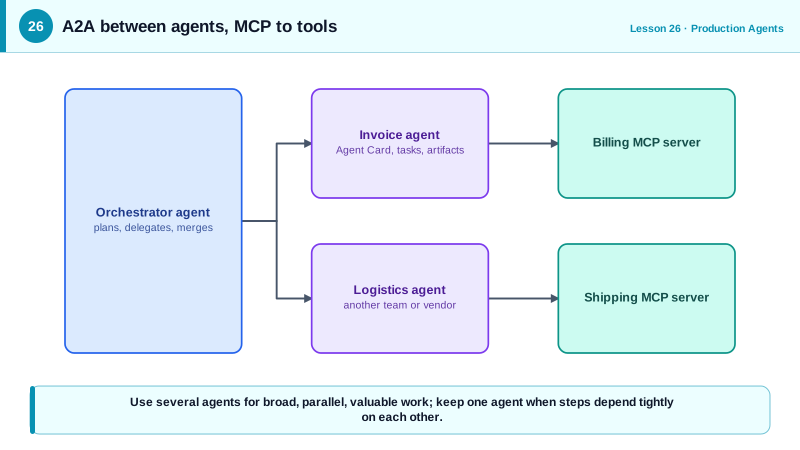
A2A and MCP solve different problems and are designed to be used together. MCP connects an agent to tools and data: the server is a capability without its own goals. A2A connects an agent to another agent: the remote side has its own reasoning, may take a long time, may ask for more input, and hides its internals. In a typical architecture, an orchestrator delegates to specialist agents over A2A, and each specialist reaches its tools over MCP.
| Approach | Communication | Best for | Main risk |
|---|---|---|---|
| Single agent | One loop, one context | Tightly coupled, sequential work | Context growth on long tasks |
| Subagents in one app | Function calls in process | Parallel research, isolated exploration | Token cost, lost details at handoffs |
| Handoffs | Conversation passed to a specialist | Triage then specialist support | Context dropped at the boundary |
| A2A across services | Agent Cards, tasks, artifacts over HTTP | Agents owned by other teams or vendors | Trust, latency, partial failure |
| MCP | Tools and resources | Giving any agent capabilities | Tool sprawl, injection via results |
Worked Example: Subagents in Code and an A2A Agent Card
The first part defines two subagents with the Claude Agent SDK, each with restricted tools and its own model. The second shows the Agent Card a team might publish so other organizations' agents can call their invoice agent over A2A.
import asyncio
from claude_agent_sdk import query, ClaudeAgentOptions, AgentDefinition

options = ClaudeAgentOptions(
    agents={
        "code-searcher": AgentDefinition(
            description="Finds where something is implemented. Use for any 'where is' question.",
            prompt="Search the repository and return file paths with one-line explanations. No edits.",
            tools=["Grep", "Glob", "Read"], model="haiku"),
        "test-runner": AgentDefinition(
            description="Runs the test suite and summarizes failures only.",
            prompt="Run the tests, then return only failing test names and the key error lines.",
            tools=["Bash", "Read"], model="sonnet"),
    },
    allowed_tools=["Read", "Edit", "Agent"],      # the main agent delegates through the Agent tool
    max_turns=30,
)

async def main():
    async for msg in query(prompt="Fix the failing invoice rounding test.", options=options):
        if type(msg).__name__ == "ResultMessage":
            print(msg.result)

asyncio.run(main()){
"name": "Invoice Agent",
"description": "Answers questions about invoices and issues credit notes for Acme customers.",
"version": "1.4.0",
"supportedInterfaces": [
{ "url": "https://agents.acme.example/invoices/a2a", "protocolBinding": "JSONRPC" }
],
"capabilities": { "streaming": true, "pushNotifications": true },
"defaultInputModes": ["text/plain", "application/json"],
"defaultOutputModes": ["text/plain", "application/json"],
"skills": [
{ "id": "invoice-lookup", "name": "Invoice lookup",
"description": "Find invoices by customer, number or date range and explain line items.",
"tags": ["billing", "invoices"], "examples": ["Why is invoice 4471 higher than last month?"] },
{ "id": "credit-note", "name": "Issue credit note",
"description": "Issue a credit note up to 500 EUR; larger amounts return input-required for approval.",
"tags": ["billing", "refunds"] }
]
}Within the coding task, the subagents keep search output and test logs out of the main agent's context. Across companies, the Agent Card lets a partner's procurement agent discover what the invoice agent can do without knowing which model or tools it uses internally; a real card would also declare its security schemes.
Real-World Examples
- Anthropic's June 2025 post on its Research feature reported that the multi-agent system outperformed a single agent by about 90 percent on breadth-first research queries while using roughly fifteen times the tokens of a chat, and concluded that multi-agent designs suit high-value, parallelizable tasks.
- Google announced A2A in April 2025 with more than fifty partners, contributed it to the Linux Foundation in June 2025 with AWS, Cisco, Microsoft, Salesforce, SAP and ServiceNow among the founding members, and the protocol reached version 1.0 in April 2026.
Review Questions & Answers
When the task is broad and can be split into fairly independent parallel subtasks, such as researching many sources, and its value justifies the much higher token usage.
Each agent sees only its own context, so decisions made by one are not visible to others. Subtasks that depend on each other's precise choices lead to conflicting or inconsistent results.
A JSON document describing an agent's name, skills, endpoints, supported content types, capabilities and security requirements. It is published at /.well-known/agent-card.json so other agents can discover it.
An orchestrator uses A2A to delegate tasks to specialist agents, which have their own reasoning and may run long, and each specialist uses MCP to access the tools and data it needs.