AWS Well-Architected Framework Explained
On this page
What the Well-Architected Framework is
Most architecture mistakes aren't exotic. A database without backups, a single Availability Zone, an admin key on a laptop, a fleet sized for a peak that never comes. The AWS Well-Architected Framework collects the questions that catch these, organized into six pillars.
The six Well-Architected pillars
| Pillar | The question | Typical practices |
|---|---|---|
| Operational excellence | Can we run, observe and change this safely? | Infrastructure as code, small reversible deploys, runbooks, dashboards and alarms |
| Security | Is access minimal and data protected? | Least privilege, MFA, encryption at rest and in transit, audit logging |
| Reliability | Does it recover from failure and meet demand? | Multiple AZs, health checks, automatic recovery, tested backups |
| Performance efficiency | Are we using the right resources well? | Right instance types, caching, managed services, load testing |
| Cost optimization | Are we paying only for value? | Rightsizing, commitments for steady load, deleting idle resources |
| Sustainability | Are we minimizing environmental impact? | High utilization, efficient instance types (like Graviton), less data stored and moved |
AWS also publishes lenses for specific workloads (serverless, SaaS, machine learning) and a free Well-Architected Tool in the console that walks you through the questions and records risks.
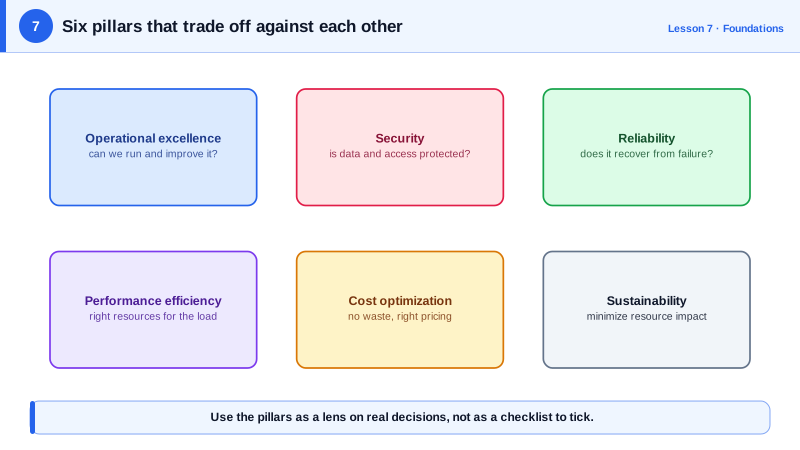
Trade-offs between the pillars
The framework doesn't say "maximize everything". It makes trade-offs visible:
- Reliability versus cost: a Multi-AZ database roughly doubles its cost; a second region far more.
- Security versus speed of change: strict approval gates slow deploys.
- Performance versus cost: larger instances and provisioned capacity cost more.
The right answer depends on the workload. A payment system and an internal dashboard should end up in different places.
A Well-Architected review of one decision
A team runs an order-processing API on a single m7g.xlarge EC2 instance with a single-AZ RDS database. They ask: "Should we move to multiple instances behind a load balancer and Multi-AZ RDS?"
- Reliability: today, losing that instance or AZ stops all orders. That's a high-risk finding for a revenue system.
- Operational excellence: with one server, every deploy is downtime. Several instances allow rolling deploys.
- Performance: two smaller instances (
m7g.large) behind an Application Load Balancer can match the capacity of one larger one, and an Auto Scaling group can add more on busy days (Day 12). - Cost: the load balancer and Multi-AZ standby add cost. Two
m7g.largecost about the same as onem7g.xlarge, so compute barely changes; the database roughly doubles. - Security: a good moment to move the instances into private subnets behind the load balancer (Day 9).
- Sustainability: smaller instances that scale with demand waste less idle capacity.
The decision: yes, because the cost increase is small compared to the cost of an order outage. For an internal reporting tool with the same setup, the same review might accept the risk.
Using Well-Architected reviews well
- Review at design time and periodically after, not once.
- Record risks with an owner and a date, and fix the high-risk ones first.
- Treat it as a conversation tool, not a compliance score.
Check yourself
Operational excellence, security, reliability, performance efficiency, cost optimization and sustainability. Each comes with design principles and review questions, and the point is to weigh them against each other for your workload.
Their workloads have different requirements; acceptable risk and cost depend on what an outage or a breach would cost each business.
Reliability and cost: running across several AZs or a second region improves recovery from failures but roughly doubles some costs. Security and performance can also pull apart, for example with extra inspection layers adding latency.
A list of risks ranked by impact, each with an owner and a decision: fix it, accept it with a reason, or revisit it later. A review that produces no actions wasn't useful.
No. It's a set of questions to help teams reason about trade-offs. Not every best practice applies to every workload.