System Design Capstone: Present Your Architecture
On this page
The capstone: design and present your own system
Design a system you care about, not one from the case studies: something from your job, a product you use, or an idea you'd like to build. Take it all the way:
- Requirements and estimates.
- A context diagram and a container diagram (Day 94, C4 style).
- The data model and storage choices.
- The main read and write paths, with caching.
- Asynchronous flows and how consistency works across them.
- Security: identity, authorization, data protection.
- Reliability: failure modes, timeouts and retries, redundancy, DR targets.
- Observability: SLOs, the metrics and traces that prove them.
- Cost: a rough monthly estimate, and the biggest line item.
- Three ADRs for the hardest decisions.
Then present it in 20 minutes to someone: a colleague, a mentor, a study group. Their questions show you where the design or the explanation is weak.
A checklist from the whole roadmap
Run your design against these questions; each points back to a module:
| Question | Module |
|---|---|
| Are the non-functional requirements written as numbers? | 1 |
| Does each external API have clear resources, versioning and limits? | 2 |
| Does each data store fit its access pattern, and how does it scale? | 3 |
| What's cached where, for how long, and how is it invalidated? | 4 |
| What happens asynchronously, and is every consumer idempotent? | 5 |
| Do service boundaries follow business capabilities and data ownership? | 6 |
| Where do you need agreement, locks or quorums, and why? | 7 |
| What fails, how fast do you notice, and what's the fallback? | 8 |
| Who can access what, and how would you find out something's wrong? | 9 |
| Which decisions are hard to reverse, and are they recorded? | 10 |
| What does it cost per month, and what grows fastest with usage? | All |
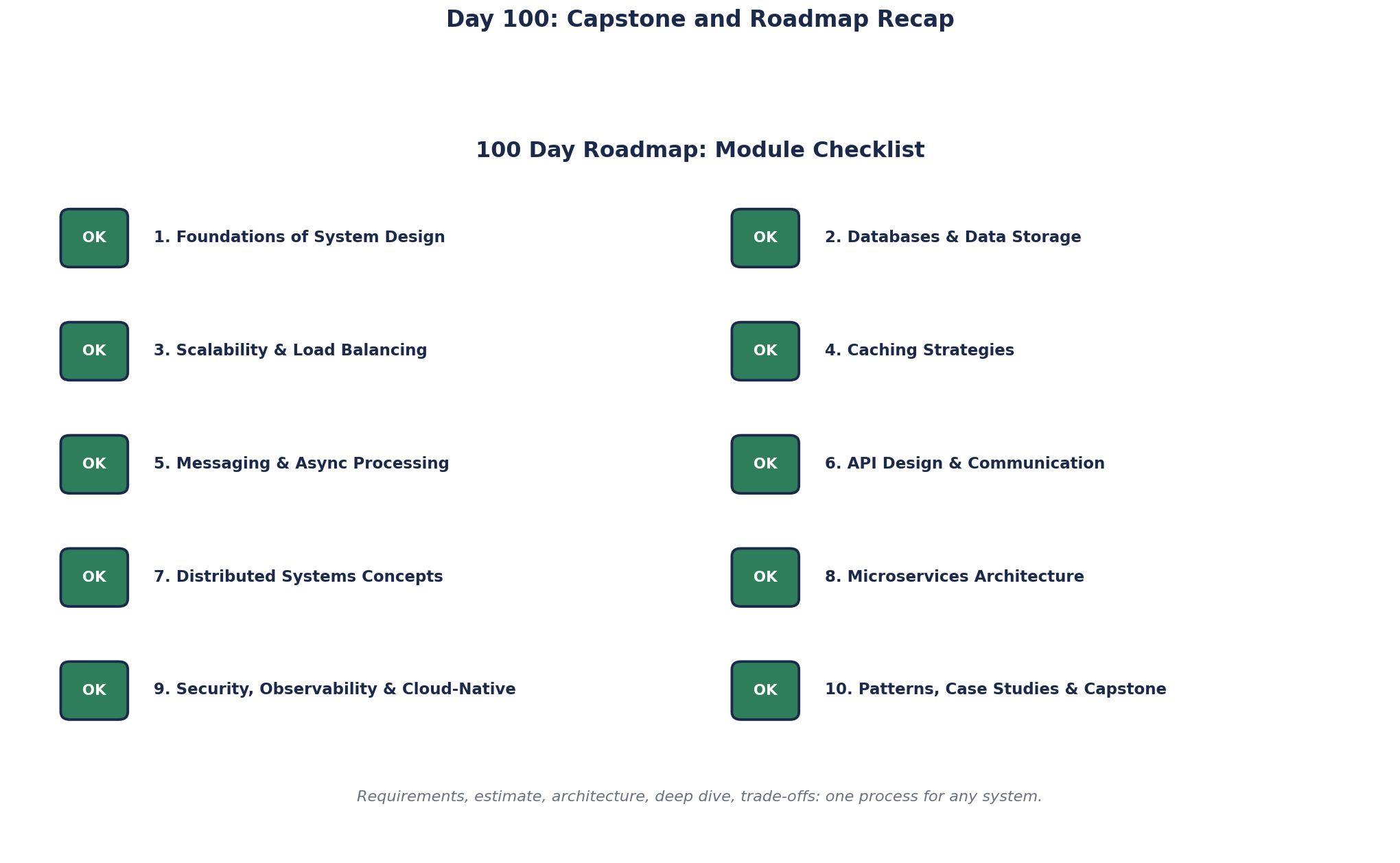
What a strong capstone includes
- Numbers that justify the scale of the design, so it's neither under- nor over-built.
- A clear story for consistency: which data is strong, which eventual, and why.
- Failure handling for every external dependency.
- Diagrams someone else can follow, and ADRs that record the trade-offs.
- A cost estimate: even "about 3,000 dollars a month, mostly database and egress" shows you know what the design costs to run and what would make it cheaper.
- An honest "what I'd do next" list.
Turning the skill into career progress
Build a small portfolio. Publish the capstone and two or three shorter designs as write-ups or a repository with diagrams and ADRs. A worked design with trade-offs says more than a list of technologies on a CV.
Use it at work. Volunteer to write the next design document or ADR on your team, run a failure-mode review of an existing service, or define SLOs for a service that has none. Visible design work is how engineers move toward senior, staff and architect roles.
Keep practicing interviews. Two mocks a week before interviewing (Day 99), on new prompts.
Read real systems. Engineering blogs and papers (Dynamo, Spanner, Kafka, Dapper, Raft) show how the ideas in this roadmap behave at scale and where they bend.
Go deeper where your work is. This roadmap's sibling courses on PostgreSQL, Redis, Kafka, distributed systems, observability and Kubernetes take individual modules much further.
Check yourself
Their questions reveal gaps in the design and in your explanation, which is exactly what an interview or design review will test.
The ones that are hardest to reverse or most debated, typically the main data store, the consistency approach across services, and the service or data boundaries.
Cost is a requirement (Day 1). Without an estimate you can't compare options or know whether the design is affordable. Price the main components and name the largest.
Write a design document or ADR for an upcoming change, define SLOs for a service, or run a failure-mode review of an existing system.
The requirements and constraints, the capacity estimates, a diagram of the main components and data flows, the key decisions with the alternatives you rejected, how the system fails and recovers, and what it costs to run. Reviewers look for reasoning, not just boxes.