Mock System Design Interview and Scoring Rubric
On this page
The mock interview: pick a prompt and set a timer
Pick a prompt you haven't studied in this roadmap, set a 45-minute timer, and design it out loud, ideally with someone playing interviewer. Suggested prompts:
- a hotel or ticket booking system,
- a notification service sending email, SMS and push at scale,
- a collaborative document editor,
- a food delivery tracker,
- a metrics and alerting platform.
Afterwards, score yourself with the rubric below.
A 45-minute system design interview time plan
| Minutes | Stage | Output |
|---|---|---|
| 0 to 5 | Requirements | Functional and non-functional lists, confirmed aloud |
| 5 to 10 | Estimates | Requests per second, storage, bandwidth, and what they imply |
| 10 to 25 | High-level design | Components, data model, one read and one write traced end to end |
| 25 to 38 | Deep dive | The hardest part, usually chosen by the interviewer |
| 38 to 45 | Wrap-up | Bottlenecks, failure handling, what changes at 10× |
Check the clock at roughly 10, 25 and 38 minutes. Running out of time before the wrap-up throws away easy points.
What the first five minutes sound like
For "design a hotel booking system", a strong opening is questions, then a short list read back:
- "Is this one hotel chain or a marketplace of many? Do we handle payment or hand off to a provider? How many hotels, and bookings per day?"
- "So: search availability, hold a room, book and pay, cancel. Non-functional: a room is never double-booked, search under 300 ms, booking can be a little slower. Out of scope: reviews and loyalty. Does that match what you want?"
Notice what the questions surfaced: "never double-booked" is the hard problem, the same contention as Day 98's drivers and Day 1's last seat. Saying "out of scope" out loud also saves time later.
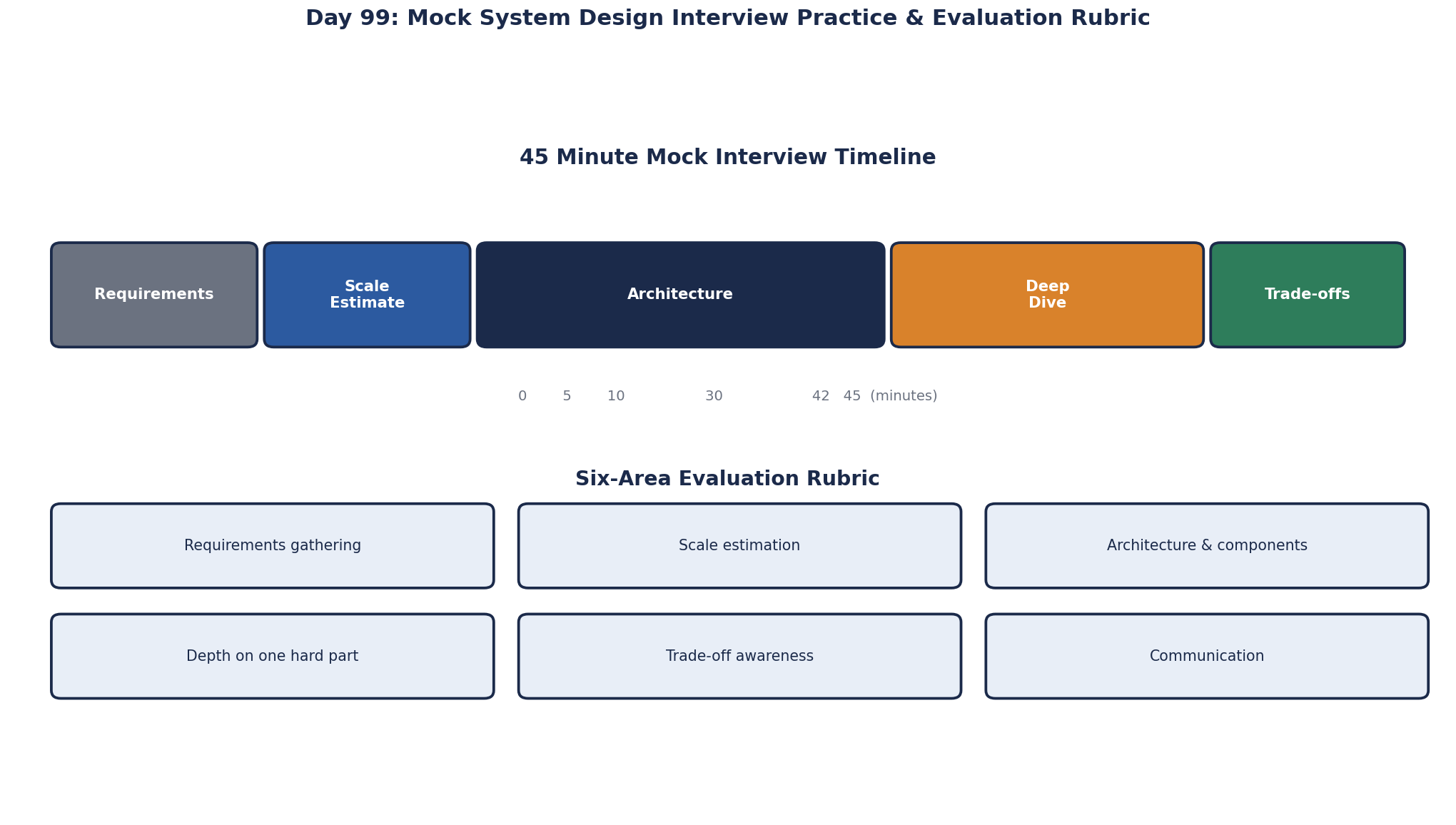
A system design interview scoring rubric
Score each area from 1 to 5 and write one sentence about what you'd change:
| Area | What a 5 looks like |
|---|---|
| Requirements | Scope narrowed to something designable; priorities asked about; list confirmed |
| Estimation | Quick, rounded numbers that drove at least one decision |
| Design | Every component justified; data model fits the access patterns; paths traced |
| Depth | One hard problem solved properly: consistency, contention, fan-out, failure |
| Trade-offs | Choices stated with their cost and with what would change them |
| Communication | Thinking narrated; diagram readable; interviewer never had to dig |
Write the sentences. "Design 3: I added Kafka without saying why" is something you can fix; "felt OK" isn't.
System design interview mistakes that cost the most
- Drawing before asking. Designing for a problem nobody posed.
- Technology lists instead of reasons. "Kafka, Redis, Kubernetes" without saying what each solves.
- Thinking silently. The interviewer scores what they hear.
- Ignoring the numbers. Sharding a system that handles 50 requests per second, or not caching one that handles 50,000.
- No failure story. Never mentioning what happens when the database, cache or a region fails.
- Defending instead of adapting. When the interviewer points out a problem, acknowledge it and adjust.
A weekly practice routine
- Two mocks a week for a month, each on a new prompt, alternating who plays interviewer.
- One deep-dive drill a week: take one topic from this roadmap (rate limiting, sharding, sagas, caching) and explain it in 5 minutes without notes.
- Track scores per rubric area and spend study time on the lowest one.
- Review a real system's engineering blog each week and ask how you'd have designed it.
- No partner? Record yourself. Talk through a prompt with a screen recorder running, then watch it with the rubric. You'll hear the silent stretches and unexplained boxes immediately.
For more prompts with full walkthroughs, the Crack the System Design Interview course works through six more designs.
Check yourself
Summarize the design quickly, ask the interviewer which area they'd like to go deep on, and keep time for the wrap-up.
A score says something went wrong but not what to change. A sentence like "jumped to components before agreeing requirements" names the specific behavior to practice next time, which is what turns mock interviews into improvement.
Two buyers getting the same seat. Atomic conditional updates or reservations with expiry (Days 1, 27 and 49), plus handling a burst when sales open (Day 73).
It names a tool without a reason. A strong answer says which interactions need asynchronous events, why, and what Kafka specifically provides, such as retention and partitioned ordering.