Vite SPA with BFF vs Next.js: Rendering Strategy
On this page
Learning Objective
Compare client rendering, server rendering, static generation and React Server Components, choose between a Vite single-page app with an ASP.NET Core BFF and Next.js for a given product, place authentication correctly in either, and avoid the security pitfalls specific to server-rendering frameworks.
Concept Explanation
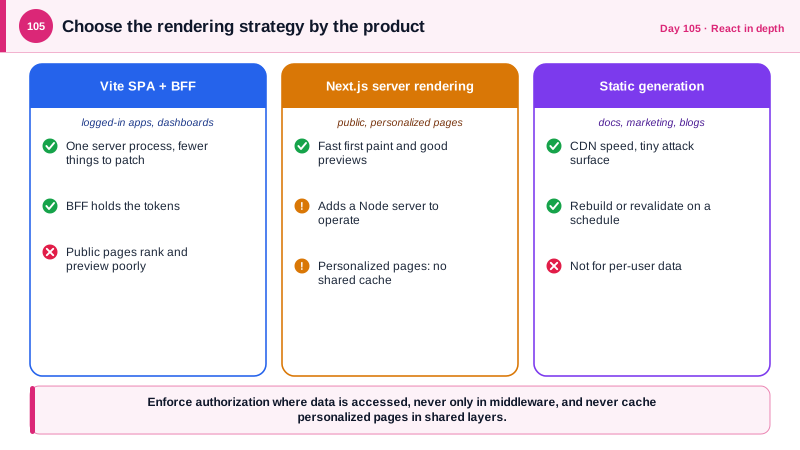
So far the React front end has been a single-page application: the server sends a small HTML shell and a JavaScript bundle, and the browser renders everything. That is client-side rendering, and for an application behind a login, such as the Task Board, it is usually the right choice: search engines do not need to index it, the first load is a one-time cost, and the architecture is simple. Other strategies move rendering to the server. Server-side rendering builds the HTML for each request, which improves the first paint and search visibility for public pages. Static generation builds pages ahead of time and serves them from a CDN, ideal for content that rarely changes. Incremental regeneration refreshes static pages on a schedule. React Server Components run components on the server and send their output to the browser, letting them read data directly without shipping that code.
Next.js is the dominant framework that combines these options with file-based routing, data loading and its own server. Adopting it changes the topology. You now have a Node.js process in addition to your ASP.NET Core API, which means another service to deploy, patch, secure, and monitor, and another network hop between the browser and the data. It can be the right trade when the product has public, search-sensitive pages, such as a marketing site, a documentation area, or a storefront, where server rendering and static generation are decisive. For a logged-in application, a Vite single-page app served with the BFF from Day 46 gives you the same security model with fewer moving parts.
Authentication needs a clear home in either design. In the Vite and BFF design, the .NET BFF holds the OIDC session and tokens, and React only asks who the user is. In a Next.js design, the Node server can play the BFF role: it runs the OIDC flow, keeps tokens in an encrypted server-side session, and calls the .NET API on behalf of the user, so tokens still never reach the browser. What you must avoid is a hybrid where tokens reach the browser and the server both. Also decide who owns authorization: the .NET API must remain the authority, since anything that can call it, including a compromised Next.js server, is a client of it.
Server-rendering frameworks bring their own security concerns. In March 2025 a critical vulnerability in Next.js, tracked as CVE-2025-29927, allowed attackers to bypass authorization checks implemented in middleware by sending a crafted internal header, which showed the danger of putting authentication only in a middleware layer instead of enforcing it where data is accessed. Environment variables with the public prefix are embedded in the client bundle, just like Vite's, and secrets must never use them. Personalized pages must not be cached in shared caches or static output, since one user's data could be served to another. Server actions are public endpoints, as Day 104 explained. And the server-side component protocol itself has been the subject of critical vulnerabilities that required urgent upgrades, a reminder to budget time to keep the framework patched.
| Dimension | Vite SPA + ASP.NET Core BFF | Next.js + ASP.NET Core API |
|---|---|---|
| Best for | Logged-in apps, dashboards, internal tools | Public, SEO-sensitive sites, storefronts |
| Moving parts | One server process for BFF and static files | Adds a Node.js server to operate and patch |
| First paint | Bundle download and render | Server or static HTML, faster for public pages |
| Token handling | BFF holds tokens | Next.js server holds tokens, same principle |
| Authorization authority | The .NET API | The .NET API, never only middleware |
| Cache risk | Static assets only | Personalized pages must never be cached shared |
Worked Example: A Decision Matrix and a Safe Server-Rendered Page
The first block is the rubric for the decision, and the code shows how a Next.js server component should fetch personalized data from the .NET API without leaking tokens or caching across users.
DECISION RUBRIC for a new product screen or app

Is the content public and does it need to rank in search or preview well when shared?
   yes -> server rendering or static generation for those pages (Next.js, or static site generator)
   no  -> continue
Is the app behind a login with mostly personalized data?
   yes -> Vite SPA served by the .NET BFF (this course's default)
Do we already run and staff Node.js services?
   no  -> prefer fewer runtimes: SPA + BFF, or static generation with a CDN for public pages
Is the team small and the product an internal tool?
   yes -> Vite SPA + BFF: fewer moving parts, less to patch
Mixed product (public marketing site + app)?
-> two deployments: static or Next.js for the public site, Vite SPA + BFF for the app, sharing a design system// app/projects/page.tsx (Next.js server component): personalized data, fetched on the server for this user only.
import { cookies } from 'next/headers';
export const dynamic = 'force-dynamic'; // never statically generate or share this page
export default async function ProjectsPage() {
const session = await getServerSession(); // reads the encrypted server-side session cookie
if (!session) redirect('/login');
const res = await fetch(`${process.env.API_BASE_URL}/api/projects`, { // API_BASE_URL has no NEXT_PUBLIC_ prefix: server only
headers: { Authorization: `Bearer ${session.accessToken}` }, // token stays on the server
cache: 'no-store', // personalized: never cached across users
});
if (res.status === 401) redirect('/login');
const projects = ProjectListSchema.parse(await res.json()); // validate what crosses the boundary
return <ProjectList projects={projects} />;
}
// The security check lives with the data access, not only in middleware.
// The .NET API still authorizes every request; this page must not be the only guard.
export async function getProjectForUser(id: string) {
const session = await requireSession(); // throws if not signed in
return apiFetch(`/api/projects/${id}`, session); // the API decides whether this user may see it
}// The ASP.NET Core API is unchanged by the choice of front end: it validates bearer tokens and authorizes every request.
app.MapGet("/api/projects", async (AppDb db, ClaimsPrincipal user, CancellationToken ct) =>
Results.Ok(await db.Projects.AsNoTracking().Where(p => p.Members.Any(m => m.UserId == user.GetUserId()))
.Select(p => new ProjectSummary(p.Id, p.Name)).ToListAsync(ct)))
.RequireAuthorization();The essential point is that both designs keep the same layered protection: tokens on the server, the API as the authority, validation at each boundary. Choosing a rendering strategy changes where HTML is produced, and should not change who is trusted with what.
Real-World Examples
- In March 2025, researchers disclosed CVE-2025-29927 in Next.js, where sending a crafted x-middleware-subrequest header could cause the framework to skip middleware entirely, bypassing any authorization implemented there. The maintainers patched it, and the guidance that followed was to enforce authorization close to the data, not only in middleware.
- Next.js was created by Vercel, then called Zeit, and released in 2016 to make server-rendered React practical, and it grew to include static generation and later the App Router with React Server Components. Its adoption made server rendering a mainstream choice for React, and also brought the operational and security concerns of running a Node.js server alongside the API.
Review Questions & Answers
The content is personalized and not meant for search engines, so server rendering gains little, while Next.js adds a Node.js server to deploy, patch, and secure. The SPA plus BFF gives the same token-handling security with one fewer runtime to operate.
Any single layer can fail or be skipped, so authorization should be enforced at the point where data is accessed, and the API should authorize every request itself. Relying only on middleware meant that a bypass exposed everything behind it.
Static generation or a shared cache stores one rendered result and serves it to everyone, which would show one user's data to others. Personalized pages must be rendered per request, with caching disabled or keyed by user.
Variables with the public prefix are inlined into the client bundle and visible to anyone who loads the site. A secret given that prefix, by accident or for convenience, is therefore published, so secrets must use unprefixed variables that only server code can read.