Optimistic Updates in React with Rollback
On this page
Learning Objective
Perform server mutations with clear pending, success and error states, update the cache after a mutation by invalidation or direct writes, apply optimistic updates with rollback on failure, prevent duplicate submissions with idempotency keys, and decide when optimism is appropriate.
Concept Explanation
Reading data is half the story; users also change it: adding to a cart, renaming a file, liking a post, submitting a payment. A mutation is a request that changes server state, and it has its own lifecycle: idle, pending, success or error. The interface should reflect each: disable or mark the control while pending so users do not submit twice, confirm success where it is not obvious, and show errors next to what failed with a way to retry, without losing the user's input.
After a mutation succeeds, the cached server state is out of date. There are three ways to reconcile it. Invalidation marks related queries stale and refetches them, which is simple and always correct, at the cost of an extra request. A direct cache write uses the mutation's response, such as the updated product returned by the server, to update the cache with setQueryData, which avoids the refetch when the response contains everything needed. Combining both is common: write the returned entity into its detail entry and invalidate the lists it might appear in, since sorting and filtering may change.
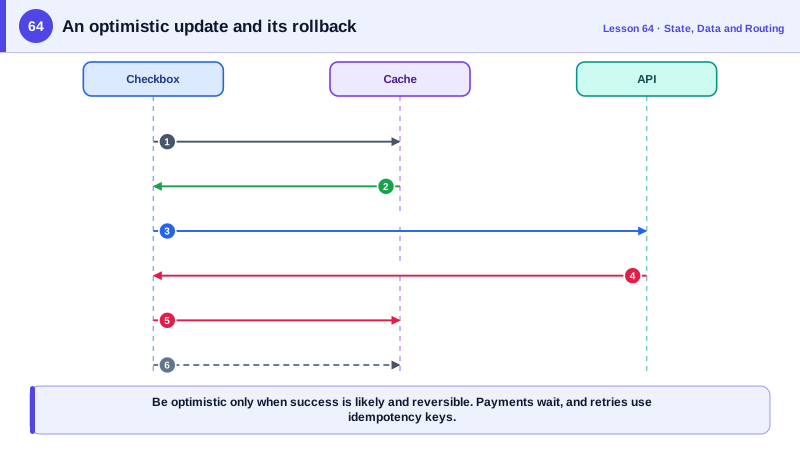
An optimistic update goes further: it updates the interface immediately, before the server confirms, on the assumption that the request will succeed. Likes, checkbox toggles, reordering and renaming feel instant this way, which matters for perceived performance. The cost is handling failure correctly. The pattern is: cancel in-flight refetches for the affected queries so they do not overwrite the optimistic value, save a snapshot of the previous data, apply the optimistic change, and if the mutation fails, restore the snapshot and tell the user. After success or failure, invalidate to reconcile with the server's truth, which may differ in details such as timestamps or computed fields.
Not every mutation should be optimistic. Use optimism when success is highly likely and a rollback is easy for users to understand, such as toggles, likes and edits of the user's own content. Avoid it for actions with serious consequences or a meaningful chance of rejection: payments, bookings with limited inventory, anything requiring server-side validation the client cannot predict. For those, show a clear pending state and wait.
Duplicate submissions are a real risk: double clicks, retries after a timeout where the first request actually succeeded, or a user resubmitting after a network hiccup. Disabling the button while pending helps but is not enough. For important operations, the client generates an idempotency key once per user intent and sends it with every retry; the server stores the result for that key and returns it again instead of performing the action twice. React 19's useOptimistic and form actions provide built-in support for optimistic UI with forms, and query libraries provide onMutate, onError and onSettled callbacks for the same pattern.
| Step | Purpose | API in TanStack Query |
|---|---|---|
| Pending state | Prevent double submit, show progress | isPending |
| Cancel refetches | Stop stale data overwriting the optimistic value | cancelQueries |
| Snapshot | Allow rollback | getQueryData in onMutate |
| Optimistic write | Instant feedback | setQueryData in onMutate |
| Rollback | Restore on failure | setQueryData in onError |
| Reconcile | Match the server's truth | invalidateQueries in onSettled |
| Idempotency key | Retries never duplicate the action | Header generated once per intent |
Worked Example: An Optimistic Todo Toggle with Rollback
The toggle updates the list instantly, rolls back and informs the user on failure, and reconciles with the server either way. The checkout button shows the non-optimistic alternative.
function useToggleTodo(listId: string) {
  const qc = useQueryClient();
  const key = ['todos', listId];

  return useMutation({
    mutationFn: ({ id, done }: { id: string; done: boolean }) => api.updateTodo(id, { done }),

    onMutate: async ({ id, done }) => {
      await qc.cancelQueries({ queryKey: key });                         // no refetch may overwrite us
      const previous = qc.getQueryData<Todo[]>(key);                     // snapshot for rollback
      qc.setQueryData<Todo[]>(key, (todos = []) => todos.map((t) => (t.id === id ? { ...t, done } : t)));
      return { previous };
    },

    onError: (_err, _vars, context) => {
      if (context?.previous) qc.setQueryData(key, context.previous);     // roll back
      toast.error('Could not update the task. Your change was undone.');
    },

    onSettled: () => qc.invalidateQueries({ queryKey: key }),            // reconcile with the server
  });
}

function TodoItem({ todo, listId }: { todo: Todo; listId: string }) {
  const toggle = useToggleTodo(listId);
  return (
    <label>
      <input type="checkbox" checked={todo.done} onChange={(e) => toggle.mutate({ id: todo.id, done: e.target.checked })} />
      {todo.title}
    </label>
  );
}

// Not optimistic: payments wait for the server, and retries cannot double charge
function PayButton({ orderId }: { orderId: string }) {
  const [idempotencyKey] = useState(() => crypto.randomUUID());          // once per payment intent
  const pay = useMutation({
    mutationFn: () => api.pay(orderId, { headers: { 'Idempotency-Key': idempotencyKey } }),
    retry: 2,                                                            // safe: the server deduplicates
  });
  return (
    <button onClick={() => pay.mutate()} disabled={pay.isPending || pay.isSuccess}>
      {pay.isPending ? 'Processing payment...' : 'Pay now'}
    </button>
  );
}
Throttle the network in DevTools and toggle a task: the checkbox flips instantly. Block the request URL and toggle again: it flips, then flips back with a message, and the list refetches to confirm the server's state.
Real-World Examples
- Stripe's API supports an Idempotency-Key header on requests that create or modify objects and returns the saved result for repeated keys, and its documentation recommends generating the key on the client so that network retries never create duplicate charges.
- React 19 added the useOptimistic hook, which shows an optimistic state while an async action is pending and automatically reverts to the real state when the action finishes, so a failed action rolls back without manual snapshot code.
Review Questions & Answers
A refetch that started before the mutation could finish after the optimistic write and replace it with the old server data, making the change appear to revert. Cancelling those queries ensures only the reconciliation after the mutation updates the cache.
Cancel related in-flight queries, snapshot the current cached data, write the optimistic value into the cache, on error restore the snapshot and inform the user, and after the mutation settles invalidate the queries to reconcile with the server.
When failure is reasonably likely or consequential, such as payments, bookings with limited availability or operations with server validation the client cannot predict. Showing success and then reverting would mislead users in situations where accuracy matters most.
The client generates one key per user intent and sends it with the request and every retry. The server records the result for that key and, on seeing it again, returns the stored result instead of executing the action a second time.